NASA LIVE.

Wednesday, 8 January 2014

Observational trajectory planetarium.

Chapter forty two as here we try to image a full plan of trajectories in our Galaxy.
This could be easily calculated with full maps of our nearest neighbour's as the sleeping giant at the center of Earths Milky Way is about to wake up. A suicidal gas cloud is heading towards the galaxy's super massive black hole, which will probably swallow the cloud, generating enormous flares of radiation that could help explain why the black hole is normally so placid.
The doomed cloud was a surprise to astronomers. "We have been looking at the galactic centre for 20 years, but mainly to observe the motion of stars," says Reinhard Genzel of the Max Planck Institute for Extraterrestrial Physics in Garching, Germany.Genzel's colleague Stefan Gillessen spotted the cloud in images from the Very Large Telescope array in Chile, taken in March this year. It is an unusually dense cloud, not much bigger than our solar system and carrying about three times the mass of Earth.
Shredded cloud The team realised that the cloud also appears in earlier images, giving them a sequence that reveals its path.
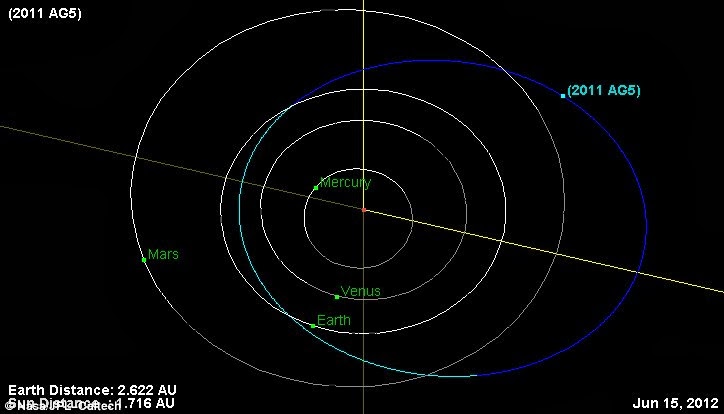
It is moving at almost 2500 kilometres per second towards our galaxy's black hole, Sagittarius A *.At present Sagittarius A * is strangely quiet, unlike quasars, the hyperactive black holes that emit huge amounts of radiation, fuelled by inflowing gas. Our black hole gets much less gas, and for some reason this starvation state makes it much less efficient than a quasar, producing only a thousandth as much radiation per kilogramme of fuel.While a star would just sail past our black hole unscathed, the loose mass of gas heading towards it is more vulnerable. It is already being stretched out by the black hole's gravity, and when it gets closer in 2013 it will plough into the halo of hot gas around the hole.
Unlucky timing that should send shock waves through the cloud to heat it to several million degrees, and according to the group's simulations the gaseous collision will shred the cloud into filaments.
This turmoil may mean that much of the cloud ends up swirling right down into the black hole."By dumping more material in there, the cloud could drive the system into a higher efficiency regime," says Ginzel. There may be one huge flare of radiation or several over the coming decades.There's no danger of the active black hole harming Earth. And though sadly not visible to the naked eye, this radiation will give astronomers clues as to why our black hole is normally so different from quasars."There is evidence that the galactic centre was more luminous within the last few thousand years, and we are unlucky in living at a time when it appears to be unusually dormant," says astrophysicist Martin Rees at the University of Cambridge, who was not part of the study.

Mars Exploration Rovers Photos.

Chapter forty one as first observed shows the indestructible wheel mechanism that was used to test the Mars Exploration Rovers on Earth before their mission is also on display below. 
After about 800 days, one of Spirit's front wheels confirmed stalled and stopped functioning there speculation that Martian landing is much more difficult procurement than an Earth type landing manoeuvre. The engineering team decided to continue driving it in reverse, dragging the broken wheel across the Martian surface but. Stunning images of the red planet taken by Spirit and Opportunity rovers are revealed in a new exhibition of photographs part of exhibition by Smithsonian's National Air and Space Museum opening in Washington 7-1-2014 exhibited  As incredible close up shows spheres, dubbed blueberries, that may suggest ancient microbial life on the planet. 
Along with ‘blueberry’ clusters, the exhibition includes photographs of craters, dunes, dust clouds and meteorites. One of the images of the Martian sunset shows a bluish colour in the sky, which is usually pink in the daytime due to the reddish dust in the atmosphere. It turns blue at sunset - the opposite of Earth. The discovery of Martian clusters, known as ‘blueberries’, a decade ago provided some of the first evidence of liquid water on the red planet. As these incredible close ups, taken by the Mars Rover Opportunity, reveals these spheres embedded in Martian rock like blueberries in a muffin. The image is part of an exhibition by the Smithsonian's National Air and Space Museum presenting more than 50 of the best photographs from two rovers known as Spirit and Opportunity. 

These hematite-rich spherules were embedded in this Martian rock like blueberries in a muffin and released over time by erosion. 
The Mars Rover Opportunity found this cluster at its Eagle Crater landing site and analysed their composition with its spectrometers. Hypotheses about their formation have contributed to the story of water on Mars. Ten years after Nasa landed the two rovers on Mars for a 90-day mission, one is still exploring, and the project has generated hundreds of thousands of images from the planet's surface. 
The Mars Rover Opportunity found this 'blueberry' cluster at its Eagle Crater landing site and analysed the composition with its spectrometers. Previous theories suggested they were created by simple chemical reactions without the help of life. However, research last year revealed clear evidence that microbes were essential in their formation.This has raised the possibility that Martian ‘blueberries’ may not only reveal that water was present on Mars - but also ancient microbial life. A view by the Mars Rover Spirit of a sunset over the rim of Gusev Crater, about 80 km (50 miles) away.
 Taken from Husband Hill, it looks much like a sunset on Earth, a reminder that other worlds can seem eerily familiar. Sunset and twilight images help scientists to determine how high into the atmosphere the Martian dust extends and to look for dust or ice clouds. ‘Spirit and Opportunity: 10 Years Roving Across Mars’, curated by the scientists who have led the mission, opens tomorrow in Washington. Along with unusual ‘blueberry’ clusters, it includes large-scale photographs of craters, hills, dunes, dust clouds, meteorites, rock formations and the Martian sunset. John Grant, a planetary geologist at the museum who is part of the rover mission team, organised the exhibition, in part as a travel log with images on one side from Sprit and images from Opportunity on the other. The rovers landed in January 2004 on opposite sides of Mars and began exploring volcanic deposits and plains, as well as meteorites and impact craters. 
As the lunar Rover tracks are shown disappearing toward the horizon in a sea of sand between the craters Endurance and Victoria on the Meridiani Plains. 
Mars rover Opportunity took the image while stuck in the sand ripple, dubbed Purgatory, for over a month ‘Every one of the images you see here tells a story of discovery that goes along with the story of beauty on Mars,’ Dr Grant said.‘It's a look at an alien planet through the rovers' eyes. The mars rover is still ’Uncovering signs of the past presence of water and a more habitable environment are among the rovers' most important discoveries. 
Some were made by accident. After about 800 days, one of Spirit's front wheels stalled and stopped functioning. The engineering team decided to continue driving it in reverse, dragging the broken wheel across the Martian surface. That dragging dug a trench behind the rover that soon uncovered a new material as white as snow. 
This piece of metal with the American flag on it is made of aluminium recovered from the site of the World Trade Center towers in New York City. It is located on Mars Rover Spirit and serves as a cable guard for Spirit, a­s a rock abrasion tool as well as a memorial to the victims of the September 11, 2001, terrorist attacks. Mars Rover Opportunity has an identical piece. Cornell University Astronomy Professor Steve Squyres (right) and it may become a near neighbour planet that might contain resemblance of future congregationalist of near outposts.  

Thursday, 26 December 2013

Pot Hole Detail Of Mars.

Chapter forty as the Mars Orbiter Camera on  Mars Global Surveyor launched November 1996 and snapped 240,000 images of layered rock formations. Space Cruising brings most of these Martian Images."Grand Canyon"—the Valles Marineris—in December 2000. NASA scientists lost contact with the surveyor on November 2, 2006. One hypothesis is that a solar panel became 'difficult to pivot', depriving the satellite of enough power to communicate with Earth. Researchers are continuing efforts to re-establish contact with the wayward probe, but the outlook is grim. "Realistically, we have run through the most likely possibilities for re-establishing communication, and we are facing the likelihood that the amazing flow of scientific observations from Mars Global Surveyor are over.
The pictures, which are ten times better than images taken in the 1970s by the Mariner 9 and Viking spacecraft, are helping scientists unravel the mysteries of Martian geology—and whether the planet ever was covered by water. The uniformity of the sedimentary layers, for example, resembles formations created underwater on Earth. In separate explorations, the global surveyor also found that parts of Mars's surface contain large amounts of hematite, a mineral that often forms in the presence of liquid water. Earlier this year NASA's Mars Global Surveyor found dark markings on the red planet's south polar cap. Scientists suspect that these markings are formed in the spring when frozen carbon dioxide rapidly transforms into gas, as seen in this artist's conception. 
Spring on Mars comes in like a lion, according to a new theory. 
Geysers formed by warming temperatures spew dust and ice hundreds of feet into Mars's air, scientists write in the latest edition of the journal Nature.An artist's conception shows the violent thawing, which takes place near the planet's south pole. Some extensive mapping occurred Mars's polar ice caps expand each winter as carbon dioxide in the planet's atmosphere freezes, the researchers say. 
But during spring, warmer weather slowly melts the expanded ice.Some of this ice becomes translucent, allowing sunlight to heat carbon dioxide below the surface, changing it from a solid directly into a gas in a process called sublimation. Eventually, the pressure from the gas becomes great enough that it penetrates the surface layer of ice in a violent eruption."These processes are unlike any observed on Earth," the researchers write. The scientists say the theory may explain a long-standing mystery: strange dark spots, fan-like structures, and spidery patterns that appear near Mars's southern pole every year. The dark spots and fans are dust thrown up by the geysers, while the spiders are the actual eruption sites, the scientists write.

Wednesday, 25 December 2013

Colonize The Planet Concept.

Chapter thirty nine as although space cruisers prefers the Planet Venus as a base mainly because of carbon and vapor and as the atmosphere is somewhat like earth. 
One would find international space station would find it easier over this planet sun rim. Rather than building complex Martian Bases as space suits would depressurize more quickly all a team would have to do is find water by drilling on this Planet Venus Surface could almost grow a colony pressure would be an inward force at surface. Although these could be built on the red planet by robots excavating underground caves, a group of German architects has claimed. 
This is a Lunar Buggy assembled as a suit case from off of the middle of the lunar lander by ram as it descended from Lunar Module its a visible relics perfect as the tracks. The team from ZA Architects believes that basalt, already detected on the red planet by rovers, could be used as a building material to create large underground caves and create a ‘Martian Cement’.‘The surface of Mars is primarily composed of basalt, and the Phoenix Lander directly sampled water ice in Martian soil,’ the team say. Martian bases could be built on the red planet by robots excavating underground caves, a group of German architects has claimed. ‘Basalt is good material to make a protection cave on, to produce insulation, and basalt roving, which is stronger than steel. ’The rovers would excavate large caves underground, leaving pillars of basalt to support the roof. When human explorers arrive, they would simply need to install windows, doors and life support systems.
The team from ZA Architects believes that basalt, already detected on the red planet by rovers, could be used as a building material to create large underground caves and create a 'Martian Cement'. 
The rovers would excavate large caves underground, leaving pillars of basalt to support the roof. When human explorers arrive, they would simply need to install windows, doors and life support systems. How its propose to build a cave on mars allow a colonists to survive cold grow a sustainable atmosphere as with rockets and digging robots are sent to Mars and search for large areas of Basalt. Robots analyse basalt columns for strength. They then drill basalt, moving down and leaving pillars of the material as large columns to support the cave’s roof. Astronauts finish the construction and arrange technical facilities as water, oxygen, windows and doors using basalt material spun as a glass-fibre like cement. ‘Curiosity sooner or later will bring human to Mars and wouldn't it be nice to have permanent station to explore it?’ Arina Ageeva of ZA Architects told space cruisers ‘It seems pretty logical to use caves as the main protective structure of the colony.'
The team even believe basalt could be used to create a ‘spider’s silk’ material similar to glass fibre that could be used as a building material. 
‘We can weave minimal surfaces that will be used as floors on different levels in the cave,’ she told Dezeen. The architects propose that roving robots will weave spatial spider-like web that will be used as spaces and construction to hold domestic and technical facilities ‘This material is already in use in the aerospace and automotive industries. It is stronger and lighter than steel, easier to operate, fireproof and it does not corrode,’ she added. 
They also believe the bases could include farming areas, saying ‘some Martian soil is appropriate for growing certain agriculture's, such as asparagus. ‘Possibility of food production will make Martian settlements independent of expensive deliveries from the Earth. ‘They also believe the bases could include farming areas, saying 'some Martian soil is appropriate for growing certain agriculture's, such as asparagus'

Tuesday, 24 December 2013

With fresh pumps via connectors.

Chapter thirty eight its happening as part of the refurbishments on the International Space Station It was the second spacewalk in four days for oncoming 2014 new year celebration.
As the US astronauts Rick Mastracchio and Michael Hopkins, and only the second Christmas Eve spacewalk in NASA history. NASA ordered up the spacewalks to revive a critical cooling loop at the International Space Station. No turkey for Christmas as astronauts Rick Mastracchio (top) and Michael Hopkins spend their Christmas Eve repairing an external cooling line on the International Space Station. It is another small step for man as astronaut Mike Hopkins (on the robotic arm , lower right). Rick Mastracchio (front) take a rare spacewalk outside the International Space Station (ISS) All nonessential equipment had to be turned off when the line conked out on 'December 11, and many science experiments halted'. With today's success , the cooling system should be restored and all equipment back up and running by this weekend, according to NASA.
Mastracchio and Hopkins removed the faulty ammonia pump during Saturday's outing. On Christmas Eve, they installed the fresh pump. Standing on the end of the station's main robotic arm, Hopkins clutched the 780-pound, refrigerator-size pump with both hands as he headed toward its installation spot, and then slid it in. An astronaut working inside, Japan's Koichi Wakata, gingerly steered the arm and its precious load . 'Mike Hopkins taking a special sleigh ride on this Christmas Eve,' Mission Control commentator Rob Navias said as the space station soared over the Pacific. It was slow going because of a balky ammonia fluid line that sent frozen flakes of the extremely toxic substance straight at the men -.. 'a mini blizzard,' as Mission Control called it The spacewalkers reported being surrounded by big chunks of the stuff that bounced off equipment and, in all probability, their suits' The ammonia needed to dissipate from their suits before the pair returned inside ', to avoid further contamination. Christmas eve spacewalk on ISS to fix broken cooling pump. Flying high' It's like Christmas morning opening up a little present here, 'astronaut Rick Mastracchio (top) said as he checked his tool kits .
Zero gravity as astronaut Mike Hopkins lies against the robotic arm during a spacewalk outside the International Space Station astronauts fix damaged cooling system in rare Christmas Eve spacewalk NASA astronauts Rick Mastracchio and Michael Hopkins ventured out of the International Space Station to repair a cooling system on December 24 It was the second Christmas Eve spacewalk in NASA history, the first was in 1999.
NASA says all equipment should be up and running by the weekend 'Wow,' Hopkins sighed after the fourth and final fluid line was hooked to the new pump. Astronauts have wrapped up urgent space station repairs during a rare Christmas Eve spacewalk, braving a 'mini blizzard' of noxious ammonia as they popped in a new pump. The electrical hook-ups went more smoothly, and six hours into the spacewalk, Hopkins finally called down, 'Houston, you've got yourself a new pump module'. Christmas references filled the radio waves, as the action unfolded 260 miles above the planet. 'It's like Christmas morning opening up a little present here,' Mastracchio said as . he checked his toolkit Later, as he worked to remove the spare pump from its storage shelf, he commented: 'Now it really feels like I'm unwrapping a present.' Mission Control in Houston was in a festive mood, despite the gravity of the situation. Tabletop Christmas trees, Santa dolls and red Santa caps decorated the desks. NASA's only previous Christmas Eve spacewalk occurred in 1999 during a Hubble Space Telescope repair mission. But NASA's most memorable Christmas Eve was back on December 24, 1968. Apollo 8 astronauts read from Genesis, the first book of the Bible, as they orbited the moon on mankind's first lunar flight.
Lost in space as the Christmas Eve venture was the second spacewalk in four days for US astronauts Rick Mastracchio and Michael Hopkins. As a bad valve in the ammonia pump caused the latest breakdown. Another team of spacewalking astronauts installed that pump just three years ago, and engineers are perplexed as to why it didn't last longer. NASA hopes to salvage it in the years ahead.
The 2010 replacement required three spacewalks because of the difficulty in removing pressurized ammonia fluid lines. But this time, the astronauts managed to squeeze everything into two after NASA reduced the pressure and 'simplified this task'. Mission Control planned to wait until Tuesday evening before fully activating the new pump, but initial testing showed everything working well. The two-line cooling system uses ammonia to dispel heat generated by on -board equipment;.. only one loop was disabled by the breakdown. It been a busy as NASA astronaut Michael Hopkins work to repair an external cooling line on the International Space Station on a spacewalk 260 miles above Earth on Saturday The second spacewalk was supposed to take place on Monday, but it was delayed a day to give Mastracchio time to switch to another suit. He inadvertently hit a water switch in the air lock at the end of Saturday's excursion, and a bit of water encroached on a cooling device in the backpack of his suit, making it unusable. Otherwise, the suits remained dry during both spacewalks. Last July, an astronaut almost drowned when water from his suit's cooling system flooded his helmet. Makeshift snorkels and absorbent pads were added to the suits as a precaution. A Moscow -led spacewalk, meanwhile, is set for Friday. Two Russian crew members will install new cameras and fresh experiments outside.

Sunday, 22 December 2013

Movements become geometric.

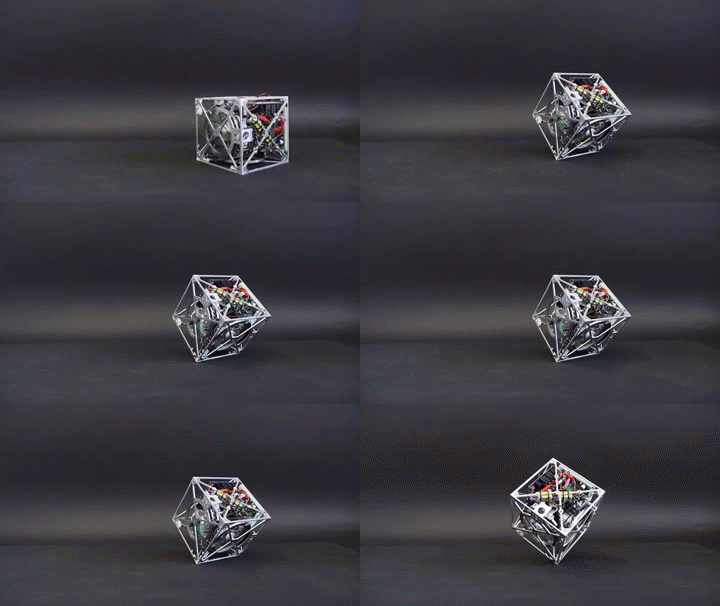
Chapter thirty seven developments on a balancing cube this will probably look like a golf ball when its science becomes exact. 'Volkswagen' could be contracted to build a prototype planet rover design. As it would be light and effective it may look like a hover-car. As it can sits just a foot or two in the air, using electromagnetic field although this uses road networks to get from A to B. Below is a design of a cube. Space Cruisers hopes bring Maneuverability as to definite a plus-point, as it can turn easily turn on the spot. Cubli can detect disturbances to adjust its position while balancing on its corner, and also rotate on the spot. Cubli is able to balance on one corner and spin for exploration of caves on Planet Venus. How does this Cubli work as sensors in the mechanical device are used to estimate the tilt of the cube and provide the angular velocity - the angular speed at which an object is rotating along with the direction in which it is rotating - of the reaction wheels, which are mounted on three faces of the cube.
The reaction wheels inside can brake suddenly to cause the Cubli to jump up from its ‘resting position’ onto one of its edges without external support, as it transfers momentum from the wheel’s to the cube’s body. Balancing on its corner is achieved by two ‘jump up’ manoeuvres. The first one raises the Cubli from one of its faces so that it can balance on its edge, while the second one raises it from the edge to one of its corners. Cubli can detect disturbances to adjust its position while balancing on its corner, and also rotate on the spot. The miniature mechanical device is able to use a ‘controlled fall’ to travel in a certain direction and when it combines its jumping, balancing and falling moves, it can ‘walk’ across a surface, the scientists said. While the technology could be used in future space explorer vehicles and self-assembling robots, the ‘cool little cube’ was simply designed to ‘jump up, balance and walk,’ its creators said.
'Cubli' - the cube that can walk, jump and balance Cubli uses two manoeuvres to jump from its resting position to one of its edges and then balance on one of its corners.
The mechanical device can detect disturbances to adjust its position while balancing on its corner (illustrated) and also rotate NASA wants to give future rovers a small electronic brain perfect for asteroids. As impressive as the Mars Curiosity’s findings have been, the rover just doesn't have the brains to cut it further out in the solar system. This is because, at the start of each Martian day, Nasa has to deal with a significant communication delay when it sends its agenda to the Mars rover. Even moving at light speed, instructions from Earth take about 20 minutes to reach the surface of Mars. This 40-minute round trip makes real-time control of the rover impossible On Jupiter's moon Europa, where astrobiologists suspect extraterrestrial life could exist, the delay balloons to over 90 minutes.
But an ‘intelligent’ camera that can not only take pictures of alien rock, but also analyse them and draw intelligent conclusions about what to do next is hoping to change all that. named ‘TextureCam’, the two-lens device snaps 3D images and a special processor, separate from the rover's main computer, analyses the pictures. By recognising textures in the photos, the processor distinguishes between sand, rocks and sky. The processor then uses the size and distance to rocks in the picture to determine if any are scientifically important layered rocks. When the Texture Cam spots an interesting rock, it can either upload a high-resolution image back to Earth or send a message to the main processor to move toward the rock and take a sample. It works similarly to the facial unlock feature available on smartphones and computers. The more examples of interesting rocks it was shown, the better it becomes at identifying the common features that make rocks scientifically important. Recently TextureCam was successfully run through its paces in the rocky landscape of the Mojave Desert in Southern California—a useful test environment for the Martian surface.

Friday, 20 December 2013

Clasping magnetic lines.

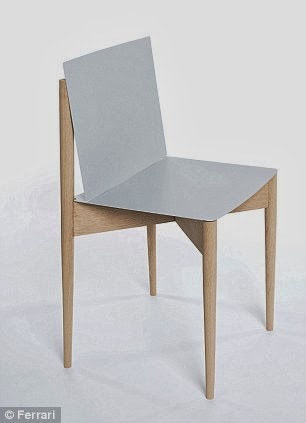
Chapter thirty six on design for the future of space cruisers may depend on magnetic clasping as a range of flat-pack furniture that can be assembled emerges.
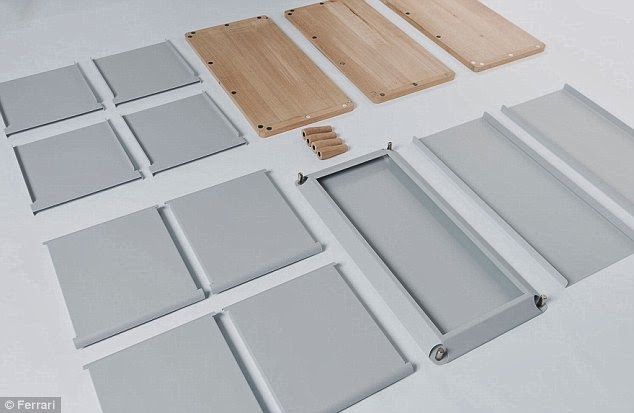
Using magnets It means that no requirement and wont get frustrated by finding missing screws, washers or misaligned screw holes when they get their purchase home. Benjamin Vermeulen reckons any piece of furniture can be assembled in just a few clicks. As he says the design means the furniture is just a sturdy as one that that has been assembled using traditional flat-pack methods. Attractive design He is a young designer has come up with a range of flat-pack furniture that can be assembled using magnets. As any of his pieces of furniture can be assembled in just a few clicks. Venus receives about twice the sunlight that Earth does, which is thought to have contributed to its runaway greenhouse effect.
Terra-forming Venus as with the use of a Doppler Effect would probably involve reducing the insulation at the surface to prevent the planet from heating up again. A space based would evolve laser sun shield. Solar shades could be used to reduce the total insulation as cooling the planet somewhat. Point of deflection from Lagrangian point also serves to block the solar wind, removing the radiation exposure. Find water float surface and drill into rock.
The use of microwave electrical currents yeald venusan minerals could prove invaluable.  As the support a future colony as H2o runs god given civilisation as with praise. The asteroid Ju 99 could prove an valuable holiday base as a self paying project ready for a Venus spaceport, similar to International Space Station into the future as laser move atmosphere allow monoxide into eddies.

This new range MAG, which stands for magnetic assisted geometry.
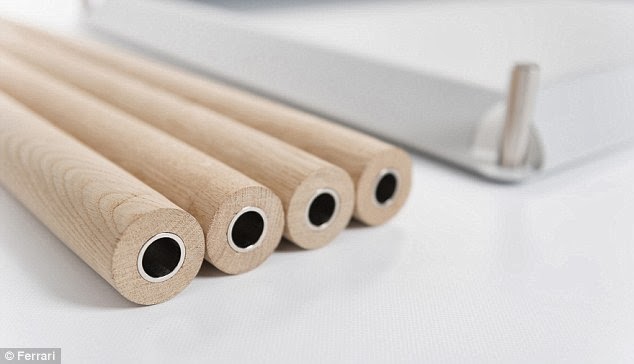
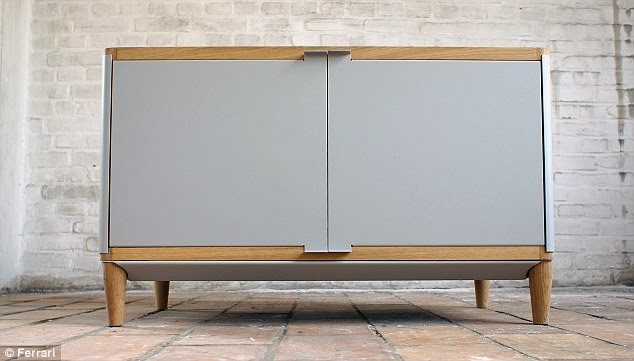
The furniture is made of sheet steel and solid wood, with magnets in the wooden parts allowing each piece to be assembled in minutes with no tools. Explaining his system, he said ' to ship furniture un-assembled is more economical and more environmentally friendly. How does it fit together The chair has a two-part frame that slots together where the leg braces cross under the seat, before a sheet-steel seat and backrest are clipped into place. With the table, metal pegs at the corners of the folded steel table top slot into magnetic tubes inside the tops of the table legs. The cabinet allows the user to select components based on the configuration they require. The basic cabinet is one layer high, but more layers of different heights can be added with or without doors or doors of different materials such as glass or steel, different layer heights.
'But flat-packed furniture is often made from low-grade material and its assembly is far from straightforward.' Assembling MAG furniture is easy, takes minutes, and requires no tools. 'The furniture, made from high-quality steel and wood, snaps together with the help of powerful magnets. 'It can be assembled and disassembled without losing its initial structural integrity.' This means you can take it apart if you are moving or selling it on. As replacing parts is easy since they come right off and reattach with the same ease. 'So far he has created a Mag chair, table and cabinet.