NASA LIVE.

Friday, 11 October 2013

Space Cruisers Designs.

Chapter fifteen some engines have been put on hold, here are some more interesting markets.
It might look a little bit like a novelty, or a static boat, even a kids house. But is space becoming intriguing enough to create sales? the market suggests concept is being ignored.  So here is a 'Space Station Three Bed', as an all in one egg design. As Belgian architects have managed to squeeze essential components of a normal home into a giant egg here is a preview drawing of a re entry design concept needs a wind tunnel as its composed of mycelium get idea. 
Design below is called the pod, which measures only '215 square feet', with more windows than one could ask for and contains a kitchen, bathroom and bedroom. This is a space saver that could be launched off a launchpad. As it is a polyester with a plywood shell its a fun 'space park'. The design was originally conceived as a solution for an Italian design firm. They were struggling to get planning permission, for an office extension. 
So here was Italian solution as architect squeezes a kitchen, bedroom and a bathroom into a giant egg that in theory could get you to a martian moon . The egg-shaped micro-house measures is just 215 square feet. But it has plenty of storage space in the form of chubby holes - that people can even sleep in 'smart'. Design was dreamed up by Belgian architects dmvA as temporary office space for a client as they couldn't get planning permission for an official extension could also fit into a loft with a circular stairwell.

Mycelium can bond together agricultural by products like corn stalks into a material that can replace plastic foam. Ecologically, mycelium's function is to break down waste. As it does this it secrets various products including enzymes, lipids, proteins, which act as glue and hold things together. 
Mycelium is the unseen part of a mushroom which consists of millions of tiny fibres. ‘Eben made the observation while he was taking a stroll in the woods, that fungal mycelium was growing on the wood chips and holding them together,’ McIntyre told   ‘The thought process was — can we use mycelium as the growing glue’ Ecologically, mycelium’s function is to break down waste. As it does this it secrets various products including enzymes, lipids, proteins. This design named Blob VB3 micro-house is made from polyester and plywood and is intended to be used as an office, guestroom or garden house. 
The pod is designed to be as big as a three bead apartment, which measures only 215 square feet, contains a kitchen, bathroom (seen at the centre of the image) and bedroom space in a polyester and plywood shell Fully lit, the house can have a warm glow inside, which looks like a yellowy egg and has multiple openings to increase the amount of living space available. The Blob VB3 micro-house came about as the local planning authority refused to give permission for any permanent structures, which enabled quirky architectural firm dmvA to come up with its aesthetically-pleasing design that is small and mobile, reported. 
The firm says its egg is easily transportable and can be used as an office, guestroom or garden house as the space is so flexible. In order to squeeze the functions of a much larger home into the micro-house, the interior was designed to have lots of cubby holes to house kitchen essentials, separate the bathroom from the main space (at the pointier end of the egg) and provide space to sleep.
It might look a little bit like a novelty static boat but Belgian architects have managed to squeeze essential components of a normal home into a giant egg. The design was originally conceived as a solution for an Italian design firm that was struggling to get planning permission for an office extensional order to squeeze the functions of a much larger home into the micro-house. 

This interior was designed to have lots of cubby holes to house kitchen essentials and separate the bathroom from the main space is full lit, the house can have a warm glow inside, which looks like a yellowy egg. People who live or work in the egg can open a large upwards-lifting door or 'nose' to create a porch or canopy,  extending their living space. Some of the cubbyholes are joined up to allow for people to sleep in 'bunks' alongside other holes which house their possessions. People who live or work in the egg can open a large upwards-lifting door or 'nose' to create a porch or canopy, extending their living space.

Tuesday, 8 October 2013

Martian moon Orbit.

Part fourteen building a self sustainable earth colony and travel into orbit this will be Planet Mars approx 6 months away it may require a base to be laden onto one martian moon. This could be done under the guidance of a small icy asteroid. Evening landing on demos this could carry a unit as it would be safe as rock. Unit could have extra advantage laser-ed out fitted tavern. This would be equivalent to baked granite rock impervious to solar radiation and it could supply ample amount of water. All that would be need to do is breath fish and grow some vegetables. Have plenty endearments from earth even have rotational laded system. These would be purpose built like Apollo craft. With  there back to sun from this hollow construction this could produce a gravitational field, it a new concept. Martian Planet could first planet for humans to land on, well demos moon would be fine as the planet Mars is so similar to Earth. Just how people would survive, breathe, eat and drink on the dry, red planet as there are significant obstacles.
Yet to be overcome one is to map this planet especially for 'caves that have there own habitats'. The US has demonstrated that we know how to get to the Moon, as "Bolden said." What we have not demonstrated and what I think everyone most people will concede, is that there are technological gaps to sending humans to an asteroid and to Mars are complex as asteroid shapes not perfected, he added . and so every single moment of our time and every single dollar of this asset venture must be dedicated. NASA are trying to develop foam as in illustration those technologies that allow humanity to go beyond low Earth orbit, live in habituates beyond the Earth Moon.
President Barack Obama has proposed a $ 17.7 billion dollar budget for NASA in 2014, and he supports a "vibrant and coordinated strategy for Mars exploration," Bolden said. Setting foot on Mars by the 2030s is human destiny and a US priority, and every dollar available must be spent on bridging gaps in knowledge on how to get there, NASA's chief says.
Addressing a conference of space experts at George Washington University, NASA administrator Charles Bolden said that despite hard economic times the United States is committed to breaking new boundaries in space exploration. "A human mission to Mars is today the ultimate destination in our solar system for humanity, and it is a priority for NASA. Our entire exploration program is aligned to support this goal," Bolden said. building foam dome structures in space could be this cost efficient step for mankind.
These are to be among the first steps to sending astronauts to Mars are NASA's plans to capture and relocate an asteroid by 2025, a process that should inform future efforts to send humans into deep space, the former astronaut said but Mapping Mars for potential cave habitats is primary objective as this Planet should show some under neath the lava spillages.
Also, US astronaut Scott Kelly has volunteered to spend one year at the International Space Station in 2015 to allow doctors to assess how long-duration zero gravity exposure affects bone density, muscle mass and vision. Currently, a rotating cast of global astronauts each spend a maximum of six months aboard the orbiting outpost.
But despite increasing interest in landing on Mars, and a newly diverse space race that involves many countries instead just of old Cold War foes the United States and Russia, there is plenty that experts just do not know about how to reach Mars. For instance, there is no existing space vehicle to carry people on the seven-month or longer journey there, not to mention no plan for returning people to Earth. Medical experts are unsure what the physical ramifications would be for people who attempt to travel in high-radiation environments for such extended periods.

Sunday, 6 October 2013

Grooved Engineering.

Part twelve with new earth orbiting techniques as this cost efficient 22-story rocket soared off a launch pad at Vandenberg Air Force Station 9-2013. 
The nine-engine rocket is its most powerful to date and designed to test the viability of using fully reusable launch vehicles for future missions. This is this the end of the expensive throw-away rocket? As private company space x launches part reusable Falcon 9 with 60 per cent stronger engines. Launch allowed space x to test technology to make launch vehicles reusable. Currently rockets fall back toward Earth and explode mid-air before crashing.This is a costly operation causing the price of launches to top $ 300 million. Neither engine restart went perfectly, but engineers were able to get enough data to plan on a demonstration flight. Next year private space flight company of space x, has successfully launched the first of its newly-improved Falcon 9 rockets. Private spaceflight company of space x allows for a more focus team management and has successfully launched the first of its newly-improved Falcon 9 rockets. This 22-story rocket soared off a launch pad at Vandenberg Air Force Station. As currently after delivering their payloads into orbit, booster rockets tumble back toward Earth and essentially experience a re-entry maneuver in mid-air before crashing into the sea.
the illustration here is growth of space skin use of an algae source, as it use for combination of products. Asteroid control using texturing can take the work out of separation as the leinden frost effect explored by design. When a liquid hits something really hot - about twice as hot as the liquid's boiling point - it never  as it comes directly in contact with its surface. This is because vapour acts as a barrier that keeps the two separated.  The skittering of water you see when it hits a hot pan is the Leidenfrost effect.  Bath University’s Alex Grounds and Richard Still looked at how droplets travel on different textured surfaces, heated at varying temperatures. They found that they could change the direction of the droplets’ movement by changing the temperature of the ratcheted surface. They also found that droplets can be made to climb up a steep incline the sharper the teeth of the surface, the steeper incline they were able to climb. And so the Leidenfrost Maze was created. The maze guides the water droplets in different directions using specially-arranged grooved hotplates. Here in this figure is growth of asteroid development true efficient processing . 
The theory is droplets change direction depending on how fast the gas evaporates from the surface of the droplet and how much the droplet is levitating, combined with the effect of the textured surface that allows it to be propelled along and even go uphill,’ said researcher Alex Grounds. This research could be used to develop more sophisticated methods for controlling small droplets and heat transfer, such as cooling systems without moving parts. If you've ever put water on a hot pan, you’ve seen the Leidenfrost Effect in action kinda groovy. The skittering and fizzing that takes place happens because the surface is super-hot- about twice as hot as the liquid's boiling point.This causes the water to levitate on the evaporated gas vapour which acts a barrier that keeps the droplet and the hot surface separated.

Friday, 4 October 2013

Luminescence gravitational photon.

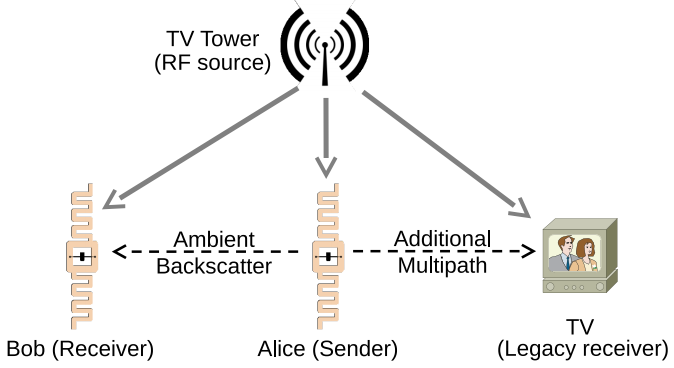
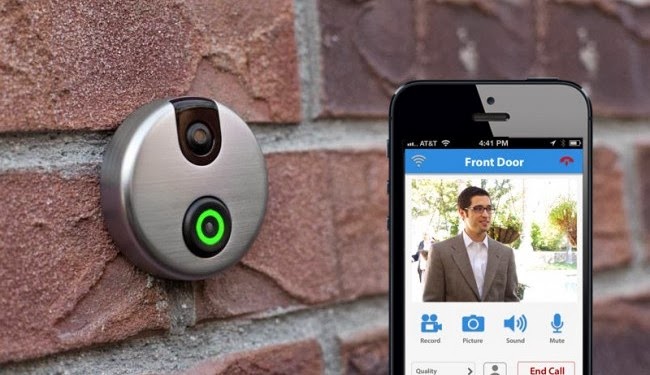
Part eleven virtual power free from 'ambient back scatter' these probes can explore other stars have bright lights and perceptive cloaking that makes them undetectable. These two devices developing computer type phone. have been researched by the University of Washington, the technology is known as 'ambient back scatter' and could potentially create networks of devices and sensors that can transmit information by reflecting existing signals to exchange information, without the need for internal batteries.
'The purpose wireless signals that are already around us into both a source of power and a communication medium, "lead researcher Shyam Gollakota, a UW assistant professor of computer science and engineering, said in release. 'It's hoped humans are going to have applications in a number of areas, including wearable computing, smart homes and self-sustaining sensor networks. phones androids all powered from ABS and luminescence from higgs boston particles "
Researchers built small, credit card-sized devices equipped with antennas that detect, harness and reflect those signals to similar devices.
The team tested the prototypes in various locations around the Seattle area, including a street corner, inside an apartment building and on top of a parking garage. Locations ranged from less than a half a mile away from a TV tower to about 6.5. miles away. The receiving devices picked up a signal at a rate of 1 kilobyte per second when 2.5 feet away from their outdoor counterparts and 1.5 feet apart when inside.
That's enough to transmit a text message, sensor reading and contact information. Researchers envision the technology being used in sensors that monitor bridges for hairline cracks. Potentially, the tech could be built in to cell phones to provide emergency power when the battery has died. While the applications are endless, researchers want to advance the capacity and range of the devices. "Ambient Back-scatter" used also for health or regulators.
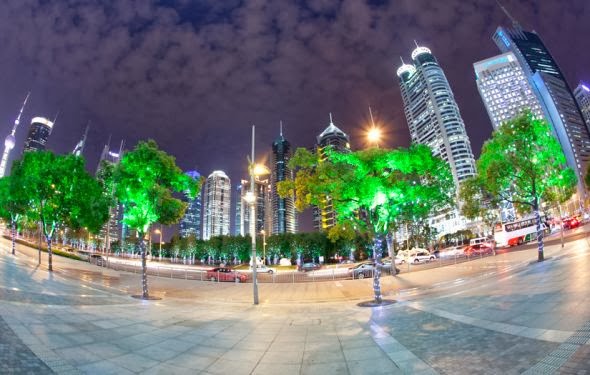
'The Biobulb is essentially a closed ecosystem in a jar', also gold nano particles make trees light right up as biochemistry major Michael Zaiken said in the project's. 'It's going to contain several different species of microorganisms, and each organism plays a role in the recycling of vital nutrients that each of the other microbes need to survive.
'Those microorganisms feed the E. coli, which will be retrofitted with a new genetic circuit to provide the code for a set of proteins that Zaiken says will" recruit, use and recycle cellular fuel "to emit light. It's kind of like making a terrarium inside a small light bulb. Bacteria is experiencing a boon as of late.
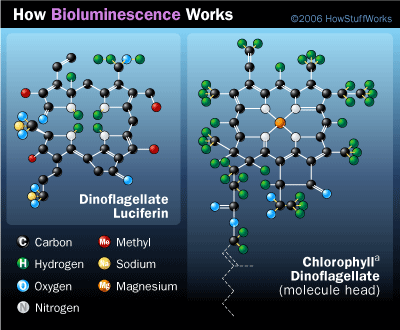
Just recently, microorganisms have been used to make another bright idea comes from scientists who are using bacteria as the key ingredient in a biological light bulb that requires no electricity. Created by three undergraduates at the University of Wisconsin, Madison, the so-called Biobulb will include a genetically engineered species of E. coli bacteria, the kind living inside the intestines of humans and other animals. Normally, these bacteria don ' t glow in the dark, but researchers plan to introduce a loop of DNA to the microbes that will give them the genes for bioluminescence. The bacteria will glow like lightning bugs, jellyfish and bio luminescent plankton.
Zaiken says the bulb could be recharged by ambient light sources found around the house during the day. The idea is that such light would feed the microorganisms that feed the E.coli, keeping them alive and repeatedly glowing for days, or even months. Researchers say they plan on experimenting with different bioluminescence proteins to determine which species' native genes produce the best glow.
"We also plan to experiment with techniques to combat mutation in the plasmid, different colored light emission, and different triggers for the activation of the glowing bacteria, "the researchers said no word yet on how much light a Bio bulb would give off, but the project is still in the development stage. As a finalist in the Zaiken and his teammates - Alexandra Cohn and AnaElise Beckman - recently launched a crowd funding campaign for an easy-to-use Bio bulb kit. "Many people don't understand what exactly synthetic biology is," Cohn says in her team's video. "What if there was a way to show people how synthetic biology can be used in a resourceful and artistic fashion? "or for space create food resourcing.

Thursday, 3 October 2013

Life In Caves Be Asteroids .

Part Ten, planetary live and existence for moon orbital dwellers. 
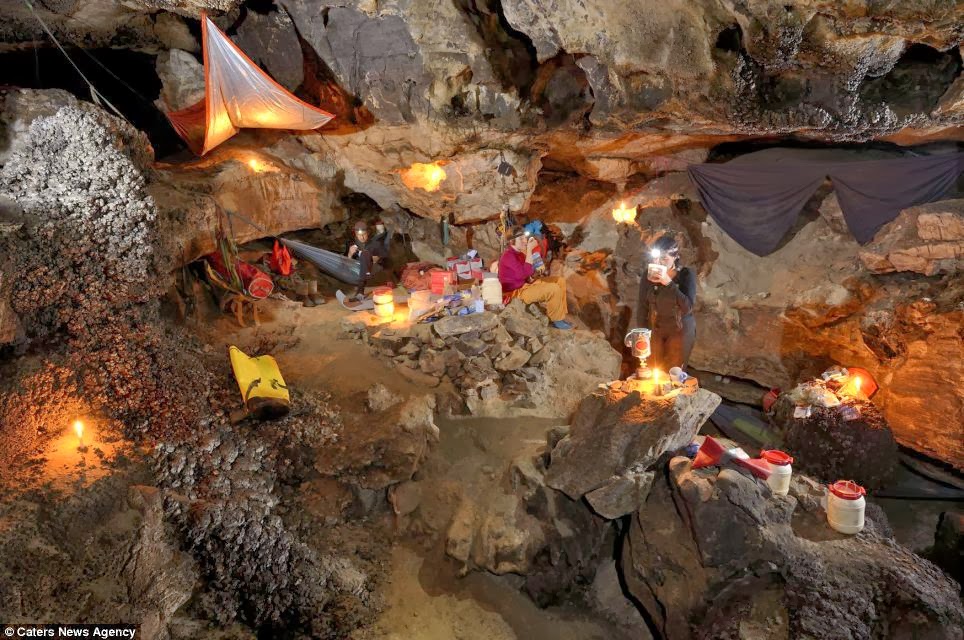
As a team of expert cavers and photographers have been exploring the vast cave system in the Chongquing province of China and have taken the first-ever photographs of the natural wonder. They were amazed to discover the entrance to the hidden Er Wang Dong cave system and were stunned when they managed to climb inside to see a space so large that it can 'contain a cloud'. The cave so huge it has its own weather system. Explorers discover a lost world with thick cloud and fogs trapped inside. The cave system was discovered in the Chongquing province of China by a team of cavers and photographers. 
Caver Robbie Shone, from Manchester, said a few of the caves had previously been used by nitrate miners but had not been properly explored. The network, which includes 'cloud Ladder Hall' measuring around '51,000 metres squared', has water sources and vegetation of the floor.
 Adventurers have stumbled across a cave so enormous that it has its own weather system, complete with wispy clouds and lingering fog inside vast caverns.The view from a small window in the wall of the vast Niubizi Tian Keng in the Er Wang Dong cave system, where clouds form inside the huge spaces. Three tiny explorers can be seen negotiating the heavily vegetated floor. 

meeting energy needs for sustaining life with space alignment for solar arrays made for fail-safe schemes for ensuring proper alignment/pointing of sun rays have sun orbits. But accordance with the safety verse efficiency the recommended transmission strength would be ‘230 W/m² in the centre of this beam’. This is about a quarter the strength of full sunlight and is thought to be a safe level it is where aircraft and birds can fly without been endangered. As in Arabia they are pushing for such systems so to meet there energy consumption.

At this level, our 3.6 km diameter collecting area would generate about 40 GWh of energy in a day, at an assumed reception/conversion efficiency of 70%. By comparison, a flat array of 15%-efficient PV panels occupying the same area in the Mojave Desert would generate about a fourth as much energy averaged over the year. So these beaming hot-spots are not terribly more concentrated than what the sunlight provides ready. As a marketing system it is only 55% more efficient without visibility still see a sun spot as in this photo above. Other alternatives less should I say exact cumbersome if a transmitter moves in orbit by a point of a degree like all satellites requires slight adjustments vector currents sand storms as earth rectifies aliments cause slight disturbances      

Wednesday, 2 October 2013

Concepts Hybrid Engines.

Part Nine progress of Skylon concept has also impressed the European Space Agency (ESA), which audited Reaction Engines' designs last year and found no technical impediments to building the craft. 
The bigger challenge may be securing funding. While ESA and the British government have invested a combined $92 million in the project, Bond and his crew plan to turn to public and private investors for the remaining $3.6 billion necessary to complete the engine, which they say could be ready for flight tests in the next four years. Building the craft itself would require a much heftier investment: $14 billion.The quest for a single-stage-to-orbit spaceship, or SSTO, has bedeviled aerospace engineers for decades. Bond's own exploration of the topic began in the early 1980s, when he was a young engineer working with Rolls-Royce as part of a team tasked with developing a reusable spacecraft for British Aerospace.
 That's when he came up with the idea of a hybrid engine. But the team struggled to figure out how to cool the engine at supersonic speeds without adding crippling amounts of weight. "By the time the plane hits Mach 2 or so, the air becomes very hot and extremely difficult to compress," Bond says. Rolls-Royce and the British government, doubtful that an easy and economical solution existed, canceled the program's funding. 
NASA and Lockheed Martin, meanwhile, had their own plans for a fully reusable spacecraft, this venture-star intended as an affordable replacement for the partially reusable space shuttle here at space cruising the design within heat exchanges could have lead to a smooth transition with seebeck effect allowing higher octane mixture out to the lux.
The company venture star demonstrator, called X-33 
(which graced the cover of this magazine in 1996), was a squat, triangular rocket that would take off vertically and glide back to Earth just as the shuttle did. Eliminating the expendable rockets needed to boost the shuttle into space could theoretically reduce the cost of launches from $10,000 per pound to $1,000 per pound. But by 2001, after sinking more than $1 billion into the project, the agency 'pulled the plug', citing repeated technical setbacks and ballooning costs. "We backed off because we felt it was better to focus our efforts on other, less costly ways to get payloads to orbit," says Dan Dumbacher, As NASA's deputy associate administrator for exploration systems development, who spent two years working on the X-33. Skylon new concept air traves at Mach 5 enters the engine and passes through a heat ex-changer  There, a network of paper-thin metal tubes filled with liquid helium chill the 2,000F air to –238F almost instantly. 
That chilled air flows into the turbo-compressor  then into the thrust chambers, where it's mixed with liquid hydrogen and ignited to produce thrust for the spacecraft. Courtesy Reaction Engines. expendable rockets make sense for missions beyond low-Earth orbit. They can haul more cargo and more fuel than single-stage craft. Rockets also offer reliability—on average, only one out of 20 launches fail, in part because they suffer no wear and tear from repeated use. Finally, rockets come with fewer R&D costs, as much of the technology has existed since the 1960s. But as space junk litters atmosphere single stage flight can offer more cost efficiency in longer term. 
But for routine missions to the ISS, or to park a small observational satellite in orbit, affordability becomes a critical consideration. 
SpaceX CEO Elon Musk told an audience at the National Press Club in 2011 that private spaceflights would need to follow a model closer to that of airlines. "If planes were not reusable, very few people would fly," he said. SpaceX plans to make rocket stages reusable, but there are drawbacks to that, too: While it is possible to recover rocket stages, designing bits and pieces to survive reentry in good working order adds a level of complexity and cost. Hempsell says Skylon could potentially make 100 flights annually—which, if true, could in its first year recoup the money spent in R&D and construction, leaving only expenses like fuel, maintenance, and overhead. And Bond's engine technology, aside from keeping a launch vehicle intact from start to finish, offers another advantage: supersonic aviation. "It could enable an aircraft to fly anywhere in the world in under four hours," says Bond. When air strikes an engine at five times the speed of sound, it can heat up to nearly 2,000 degrees Fahrenheit. Bleeding off that heat instantly, before the air reaches the turbo compressor and then the thrust chamber, was the most onerous technical challenge for Reaction Engines engineers. Bond's solution is a heat exchanger that works by running cold liquid helium through an array of tubes with paper-thin metal walls. As the scorching-hot air moves through the exchanger, the chilled tubing absorbs the energy, cooling the air to minus 238 degrees Fahrenheit in a fraction of a second. Bond says his exchanger could handle about 400 megawatts of heat (equivalent to a medium-size natural-gas plant). "If it were in a power station, it would probably be a 200-ton heat exchanger," he says. "The one we've built is about 1.4 tons." For rocket scientists, nothing matters more than weight. "Each pound you put into orbit requires about 10 pounds or so of fuel to get it there," says NASA's Dumbacher. "The challenge with the SSTO has always been to get the craft as light as possible and generate as much thrust as possible." Bond estimates that Skylon would weigh about 358 tons at takeoff and hold enough hydrogen fuel to carry itself and about 16.5 tons of payload—about the same capacity as most operational rockets—into orbit. If and when the engine passes flight tests, one of Reaction Engines' plans is to license the technology to a potential partner in the aerospace industry. Bond hopes the recent success of the heat exchanger will inspire interest. After 30 years of research, it has certainly inspired him. "It represents a fundamental breakthrough in propulsion technology," he says. "This is the proudest moment of my life.

Tuesday, 1 October 2013

Magnetic launch paths.

Part eight eletro-magnetic launches from Cape Canaveral. As NASA is forced to compete, thanks to its recent budget cuts, is trying to get around the loss of money without  a big loss of their space program this there renowned monopoly. NASA's solution launch a craft to hyper-sonic speeds with a gigantic electromagnetic rail gun, then have an air-propelled scram-jet take over after launch. due to atmosphere mach five causes atoms to stick to the skin of the craft there are solutions to repel these into a streamline. The proposed launch method will definitely improve NASA image as a world leader while keep costs down while continuing on our path to learn more about our universe. 
Plus you can't go wrong with a launch mechanism that involves using electromagnetic energy to fling a spacecraft to about Mach 3. Thus sending a man out into space hasn't really gotten more cost-effective over the decades. So as they don't want to waste as many billions on disposable rocket stages., but again, the amount of energy needed to send a man (or woman) into orbit just costs too much time and resources. by conventional launching as this be a little like a space port with reusable parts only fuel is needed two small oxygen tanks. for this sub orbital cargo space craft. This is nightlight scenario but ‘Inter changeable satellites turned into probes with repairable parts for planetary or planet studies and retrieval parts’ would bring about a solution so to conserve resources. 
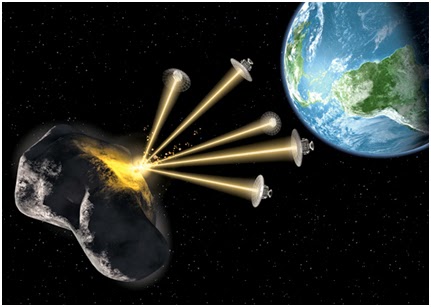
This is where nonoperational probes or orbiting satellites can be refitted in space and avoiding the kessler effect (collision cascading or ablation cascade causing plumes rendering each other inoperative , proposed by the NASA scientist Donald J. Kessler in 1978, is a scenario in which the density of objects in low Earth orbit called (LEO) is high enough that collisions between objects could cause a cascade-each collision generating space debris which increases the likelihood of further collisions. One implication is that the distribution of debris in orbit could render space exploration and even the use of satellites, unfeasible for many generations. Every satellite, space probe, and manned mission has the potential to create space debris. A cascading Kessler syndrome becomes more likely as satellites in orbit increase in number and old satellites become inoperative. One technology proposed to help deal with fragments from 1 cm to 10 cm in size is a laser broom, this proposed multimegawatt land-based laser that could de-orbit debris. The side of the debris hit by the laser would change trajectory and create a thrust that would change remains of the fragment until it would re-enter harmlessly.
Orbital decay is much slower at higher altitudes where atmospheric drag is insignificant. Slight atmospheric drag, lunar perturbation, and solar wind drag can gradually bring debris down to lower altitudes where fragments finally re-enter. But this process can take millennium at very high altitudes. The Kessler Syndrome is especially insidious because of its domino effect and plume paths wherein impacts between objects of sizable mass spills of debris from the force of collisions. The shrapnel can then hit other objects, creating even more space debris. based on the assumption weapon stockpiling. So if a large enough collision or explosion were to occur, such as between a space station and a defunct satellite, or as the result of hostile actions in space, then the resulting debris cascade could render low Earth orbit essentially impassable. So  designers of a new vehicle or satellite are frequently required to demonstrate that it can be safely disposed of at the end of its life. For an example by use of a controlled atmospheric re-entry system.